
Knee Bone Connected to the Thigh Bone

Export to PDF | Export to DOC

Easter!! Rebirth!! Spring and Easter Egg hunts! This Sunday my sister had an Easter Egg hunt for her grandchildren and our grandson. It was absolute chaos with the little ones running around trying to get the eggs and eat the candy inside before their parents caught them. The children were all beautiful, charming, funny and wonderful. I think my own parents would have loved to be there. I still hear my mother’s laugh sometimes.
Ever wonder why when you least expect it, you hear one of your parent’s words coming out of your mouth? Maybe even think beyond that and wonder if it’s your parent’s words or their parents. Families are such organic entities. We not only share genes, appearance, personality, but also strange mixtures of all of the above. Anytime we have a family gathering I think of that. I see my own sons, my grandson, my nieces, nephew, and their children and begin to see all the various connections. Whenever a baby is born a female relative, (rarely a male), will begin this by saying. “He looks just like his mother, father, sister, grandfather etc”. The connections begin.
Then families begin imparting values, language, beliefs and everything else.
Sometimes families can pass on qualities and values that are not very positive. This can open them up to severe criticism from others who simply don’t understand where that has come from. My maternal grandparents emigrated from County Cork in Ireland in 1902. The reason they came is still somewhat mysterious. My grandfather was the oldest son of a farmer. Supposedly the farm would have been his, but Ireland at that time was suffering from overwhelming poverty. County Cork was also the site of much political turmoil due to still being under English rule. It is uncertain if they came to better themselves or to escape. He and my grandmother also sponsored a number of their relatives from Ireland so they could emigrate.
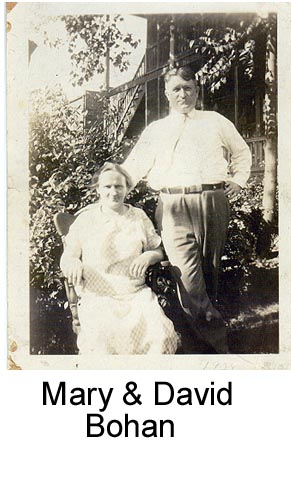
 

David & Mary BohanMy grandfather’s trade was listed as a blacksmith. Now this was in the beginning of the 20th century. Automobiles were soon to become regular means of transportation and blacksmiths were not needed as much. They had six children. Five survived. Their oldest son died as a child from heart disease due to complications from scarlet or rheumatic fever. They were able to buy a brick 2 flat on the south side of Chicago. They could augment their income by renting one of the apartments. They survived the great depression and were able to keep their house. My grandmother was supposedly a very good financial manager. She had to be. My grandfather had a number of different jobs in factories and as a watchman. He may have had a drinking problem. He certainly had some difficulty adjusting to the complexities of modern life. My grandparents depended on money from their older children to survive. Thus was due to my grandfather’s difficulty in keeping jobs and also to the economy of the times. They never saw any of their children get married and may have tried to prevent all of the marriages because of their growing financial dependence on their children.
In the post war period neighborhoods began to “change”. This meant that black families were trying to improve themselves by moving to nicer areas. There were “Blockbusters”. This usually meant the first black family to move into an area. This caused much conflict. Neighborhoods were strictly divided in those days into Irish, Polish, and Italian areas. There was concern that black families would not just take over the neighborhood, but also take over the few jobs available then. In the late 1940s this happened in my grandparents neighborhood. My grandfather had stopped working by that time. He was probably 70-71 years old. There was a riot due to a black family moving in. The police had to be called to control it. My grandfather went to see what was going on. He saw the police struggling with a young friend of his. He tried to intervene and was arrested himself. He was in jail at least overnight. This was devastating to him. He had his first heart attack shortly thereafter and was dead within six months.
Due to this and the circumstances of the times, the whole family had a strong prejudice against black people. The family moved and became part of the “white flight” from the city to surrounding suburbs. The “N” word was used frequently. Not only had our grandfather died, but we also all had to move out of our comfortable environments. This was the way we grew up. It took a lot to change. There was family resistance to that change and some family members still hold on to the old ways.
Our generation went thru all of the civil rights movements, assassinations, Vietnam, to struggle to make some progress. Our children are now often colorblind and can’t understand how anyone can have prejudice because of the color of someone’s skin, religion or their sexual orientation. There are obviously still remnants of these old beliefs and values in certain areas and groups, but there is progress. I am proud of both of my sons and their partners in the beliefs they all have. I see them being passed to my grandson. Someday he will certainly wonder where a certain phrase came from, but he hopefully won’t have to deal with some of the more negative values his grandparents dealt with.

So Simple Even a Child Could Do It

Export to PDF | Export to DOC

Age and wisdom do not necessarily go together. This was brought home to me again rather forcefully thru recent contacts with my 4 y/o grandson. My wife and I watched him last week for five days and nights while my son and daughter-in-law were at a conference in Portland, Oregon. I thought this would be a rather simple undertaking since we did raise my son who is now 37 and his brother who is 33. Both of them made it to their advanced ages with only a few scars that of course have been blamed on us. So watching a 4 y/o for a week should have been no problem.

It really wasn’t. My grandson is wonderful, bright and very funny. What was not bright and funny was his car seat. Most of us remember car seats as fairly simple. You strap the kid in and take off. My parents didn’t even have car seats. They had a station wagon and would lay the seats down so we could sleep in the back. I still remember rolling around trying to get comfortable. With our own children we had fairly simple car seats. They were not difficult. Sometimes a child would get out on his own, but no big deal. My wife does remember a time she was driving on the expressway when our oldest son was 3 or 4. He got out of the car seat and put a plastic bag over his head as a joke, but no very big deal. She got it off of him quickly. Probably because of stories like that car seats have become much more complex.

We were originally told that the car seat we purchased for our grandson would have to be installed by the fire dept. I thought this was joke, but it really wasn’t. We were told how to do it and did get it done. When he was an infant, the car seat fit perfectly. Now that he is older he hasn’t been in it for a while. We picked him up at his day care and tried to get him in the car seat. The straps were not adjustable and the clips to the harness were almost impossible. Once we got him in I wasn’t sure we would be able to get him out. The next morning I had the same problem and I kept hearing my grandson say, “Grandpa this is too tight”. I had fears of my grandson having a high voice for the rest of his life because of the damn car seat. I read the instructions again and still couldn’t fix it.

Finally I gave up. When we took him to daycare, I asked one of the teachers for help. She was about 22 and looked about 17. She asked what kind of car seat we had. When I told her, she sighed and said she had the same problem with her own baby. She came out and showed me this secret button that you push to adjust the straps. After that no problems and my grandson’s testicular development can continue.

The whole episode made me think how difficult it is to ask for help. Most of us don’t want to. We prefer to do it on our own. Asking for help can be a sign of weakness, especially for something as simple as a car seat. Getting over depression, anxiety, grief, addiction shouldn’t be that hard. “Snap out of it”, “Just say No” “ What are you, a Pussy” are phrases we all have heard either from self-talk or from those close to us. Often that’s all that’s needed—but what if it doesn’t work.

What finally motivates someone to reach out and ask for assistance? What has to happen? The German Co-Pilot who crashed the plane and killed over 150 people is said to have had a history of depression and suicidal ideation. He was in therapy and apparently made progress and then stopped. Anti-depressant meds were supposedly found in his home and it is unclear if he was still on them. One of the problems all therapists have to deal with is non-compliance or “flight into health”. The process of recovery is not structured like an escalator. There are frequent stops and starts and often long delays. It is easy to get frustrated and even to give up. If you achieve some initial growth and think you got it beat and then fall back, that can be devastating. No one knows if that is what happened to the German pilot. I have had patients feel better, stop their meds and stop therapy. Then a few days, weeks, months, years later I would get a desperate phone call asking for help. Humans are not machines that simple oil changes and replaceable parts can fix. Sometimes it takes constant care.

This care doesn’t need to be daily contact or weekly sessions forever. One old research paper found out that people could attain a more stable recovery by having longer contact with a provider. I had one family who would send me a Christmas letter every year after their daughter’s treatment. This went on for almost thirty years. They would come by occasionally for other family problems, but the fact that they knew I was there and would be there for them made it a lot easier to ask for help when they needed it.

I just have to keep reminding myself of this. Nobody knows everything. We are all experts in some thing and ignorant in others. Knowing when to ask for help and guidance is what’s important. Trying to accept this continues to be a life long adventure.


But Seriously Folks–

Export to PDF | Export to DOC

Humor is an essential element of therapy. I once read that if you don’t have at least one laugh during a therapy session, it wasn’t a good session. A lot of my humor comes from my family. I was raised in a very loud, dramatic, funny Irish American family. My grandparents on my mother’s side were from Ireland. My father was ¾ Irish and one quarter French Canadian. My mother’s family was the dominant family in our lives. Much of the humor was fueled by alcohol, but there were many humorous incidents. Once one of my uncles convinced my father and the other brother-in-laws to help him at his lake cottage. It was a very warm day and the work was hard. At the end of the day he suggested they all go for a swim. . Since they didn’t have bathing suits they all went nude into the water. My uncle snuck out and got a spotlight out of his car. Every time one of the guys would try and get out of the water he would shine the spotlight on them so everyone around the lake could see them. This went on for about half an hour. They finally rushed him and threw him in the water with all his clothes. This was the same uncle who as a child gave all of his friends ExLax as candy.

I remember another family party when I was about 14. The men were in my cousin’s basement and one of my aunts wondered why I didn’t go down and “join the arguing with the rest of them!” I think laughter is one of the most important ways to work thru depression and anxiety. If you can find a way to laugh at yourself and your situation, it can be the start of a healing process. Obviously when there is a loss and grief is foremost that has to be dealt with, but laughter is often the way to begin. Irish wakes are an example. Many of the stories about Irish wakes are indeed true. Bars around funeral homes were often extremely profitable. It’s not so much that you’re celebrating death (although that was the case with some of my relatives), as much as recognizing mortality and celebrating the life of the person who died. James Joyce wrote about this in “Finnegan’s Wake”. This was his retelling of an old Irish story of someone waking up at his own wake because of the noise of the celebration.

I would often try and get my patients to smile and laugh. I would try and do this at my own expense or by gently confronting them about their own behavior. Confrontation is often misunderstood. It doesn’t mean yelling, screaming and insulting someone. It just means presenting their behavior to them and asking them to consider alternatives. Salvador Minuchin had one of the best descriptions of how to confront someone. He said “Before you hit someone over the head, you have to pat them on the back three times”. There has to be a relationship first before any confrontation can occur. It can happen in the first session depending on how it goes. I would often try and “join” an individual, couple, or family by imitating their speech patterns or language. I would try and share an experience they had by telling one of my own just to become part of their experience. I think my own belief in not trying to take myself so seriously helped in this. I always thought that it wasn’t me that was getting someone better—that was up to them. My job was to present an accurate picture of their lives and their problems so they could work on making a decision to change.

The decision to change is often very difficult. Often even the thought of change is overwhelming. There were even some people who came in and saw death, even suicide, as the only solution. I would always take this seriously and try and get them to make some type of agreement with me to not hurt themselves. If they couldn’t do it, I would hospitalize them. Sometimes people would lie and make attempts to kill or injure themselves. Unfortunately some of them were successful. This was always difficult to accept and work thru. I am probably still working thru some of it. I often remember my failures more than my successes. The ability to laugh at myself usually helps. I know that over the last seventy years I have provided myself with enough material. I just have to keep working on the jokes.

Do Good Fences Make Good Neighbors ?

Export to PDF | Export to DOC

So how much can you care? Boundaries are a difficult thing to explain. It’s simple to define them as where I end and you begin, or a fence to keep me in and you out. I don’t know if that’s enough. Freudian analysts kept a clear distance and always worried about transference and counter-transference. Some west coast therapists in the 70s thought that there were no boundaries and sex was a great way to help patients. Some psychiatrists now act like family practice MDs with only 15-minute medication visits. They see so many patients that they have trouble remembering their names. Some family practice docs act like psychiatrists and that is both good and bad. They can offer real warmth and interest, but often times they can RX the wrong med or advice.

There have been countless books on boundaries and co-dependence and there will probably be countless more. Therapy presents some unique issues with boundaries. Whenever someone comes for “help”, they are automatically in a vulnerable position- but so is the therapist. I got to the point that I didn’t think I could work with someone if I couldn’t find something to like. Usually I could find something. Virginia Satir was great at this. She once told the wife of an ax murderer that he was only trying to make contact with her when he tried to kill her and this showed how much he really cared. Now I couldn’t do that. I did refer out a particularly nasty man with narcissistic personality disorder. I just got tired of the way he talked about the women he was abusing. He was also trying to build a case against his ex employer and filing for psychiatric disability. I just got to the point that I couldn’t stand to listen to him.

Now I know that this isn’t the way it is supposed to be. It’s hard enough to make a decision to go for help, and now what happens if your therapist doesn’t want to work with you ? Carl Whitaker ,one of the founders of family therapy, once said “I care very easily, but you have to make me care”. It didn’t take much. I think all I asked was for a person to make a reasonable effort to take some responsibility to change . As long as I could see that , or see where someone was trying to even get to that point, I would be fine. This does get back to the question of how much to care. The problem is always if you care more than they do. Sometimes you can care too much. I think that is the danger of being swallowed up in someone else’s life. It is a very fine line to walk. Robert Frost wrote about his neighbor saying “Good Fences Make Good Neighbors”, but he wonders about that. Before he would build a wall he wants to know what he is walling in and what he is walling out. If you build stone walls you have to be careful because they can crack. If you have no walls you are at the mercy of everyone’s emotions and crises. What price do you pay for this?

“Burn Out”, “ “Compassion Fatigue”, “Vicarious Traumatization” or whatever words are now being used for being overwhelmed with work. I have had lots of people ask how I could hear other people’s problems all day long. Did it ever affect me? Of course it did. Most days I would be able to leave ,get in my car, start blasting the Rolling Stones,and let it all go. However some days I wouldn’t be able to. I think as I got older and more experienced those days got fewer, but my family might disagree. I know that by the end of the week I was tired. Usually I would have Friday off. My wife would go to work and I might sit in a chair and read. The windows would be closed with the curtains drawn. It wasn’t that I liked the dark , it was just that I wanted privacy with no other distractions. I would rationalize this as my own recovery time. Exercise helped this too. If I ran or did some other strenuous exercise, I could focus on that and not on work. By the time my wife got home I was usually better. The rest of the weekend would fly by and before I knew it, I was back at work. I think the clinic was a good place where wonderful work was done. I also think that because of the work, I would get so caught up in the process and the very number of patients, that I didn’t  realize what was happening to me. I think the importance of focusing on self care is often neglected. The less I took care of myself, the worse my own boundaries were. I could always tell when I was getting to the edge when I would argue with a patient or get in a “power struggle” because they weren’t listening to me. The reality was I wasn’t listening to them.

Retirement is still strange. It’s like I put my instrument in the closet and haven’t taken it out for two years. I can try it on my wife and family, but I don’t think they want to hear that kind of music from me. One of the changes now is that the curtains are always open in our house. Sometimes I still want the dark, but I am getting used to the light and still working on new music- and new walls. I need to work on gates and maybe learn about picket fences that you can see thru and lean on and sometimes reach across. I think I am at least getting more ready to try.

It Might As Well Be Spring

Export to PDF | Export to DOC

It is now in the high 40s outside and we all are beginning to think we live in Florida. The sun is out. The birds are singing. Hell yeah!! I think the winter was really starting to wear me down. Now I have no real excuse for any lack of motivation due to snow and cold. I still have these mood shifts. I still flip from idea to idea. Maybe that is what not working means. I think the external structure that work provided was good for me. I would look forward to my time off and to occasional vacations., but I always would go back to the job. Now I have this big long vacation. Today one of the guys in our breakfast club was late and he told us time just got away from him because he really doesn’t have any time now. We all started to talk about that. The every day is Saturday is OK most of the time, except when it isn’t.

I just finished the David Carr book “The Night of the Gun”. Good book! At times it was like a lot of drunk-a-logs and TIW (There I Was) stories, but it confirmed again the importance of accepting addiction as a disease that you don’t get better from. He was a very passionate guy and I’m glad he got back in recovery before he died.

His website is interesting too. What he did was buy a video camera and an external hard drive and go around and interview people who knew him when he was using, and when he was in recovery. I started to think about the possibility of doing something like that about recovery. We’ll see how that goes.

I still go back to how important it is to find meaning in life. I still don’t think you can tie up all your meaning to a relationship with another person. What happens when that person dies? Or the relationship ends? I have seen what happens in my own family. My mother was lost despite having two young children still at home. My cousins, who have lost their spouses, still have a difficult time. They begin to feel as if they have lost half of themselves. The grieving is important, but you still have to hold on to your own center while you go thru it.

The thing about recovery is that it doesn’t mean just stopping alcohol/drugs/etc. It means that you have to find some meaning apart from the addiction. Sometimes the meaning is there and it is clear as glass, but then it begins to cloud up. Victor Frankl’s opening statement to his patients about what stop you from suicide is still important. Where do you find meaning? ? It’s easy to get lost in materialism. Get more things!! Get new things! No matter how much you have or get, sooner or later, it is just not enough.

The whole concept of accepting a higher power is essential. This doesn’t have as much a religious meaning as a spiritual one. I remember one guy who told us a bus was his higher power. Just before we were going to commit him, he explained it. He couldn’t drive and this bus would pick him up and take him to his meetings and to his treatment. He began to talk to the drivers and they were always supportive. In a way it made sense because he was a very lonely guy. The support groups he was in meant everything to him. They helped in his process of finding himself. I think all good relationships do that.

Maybe what I am trying to clarify for myself is still about growth and self-discovery. I keep thinking that I understand myself and my own process and then it just slips away again. We would always make jokes about people who spent all their time contemplating their own navels. I am not talking about that so much as being comfortable in my own skin. I can’t expect perfection or the constant insight into myself. I just want to understand the process better.

One Christmas Eve many years ago, I was putting together a very complicated toy for our children. My wife was wrapping presents and kept asking me how it was going. I kept telling her how hard it was. She finally asked, “What do the instructions say?” I never looked at them because I thought I could just do it by myself. It was a lot easier with the instructions. I know that there is no real set of instructions for this apart from keeping at it. I just have to keep working on this. Domeena Renshaw, the sex therapist from Loyola, would often tell our patients a story. She said that if all you focused on during sex was the orgasm it was like taking a trip to the Grand Canyon with your eyes closed. If you finally opened them up at the Grand Canyon (orgasm), great! —but you missed all the scenery along the way. I would like to enjoy more of the scenery on this journey.